History of the Stars and Stripes
Flag Day is celebrated on June 14 every year. It commemorates the adoption of the first flag of our nation, with 13 stars and 13 stripes, on June 14, 1787. Nine years and one day later, the newly-formed Town of Hamden held its first town meeting. In conjunction with the celebrations held in 2026 for both the 250th anniversary of our nation and 240th of our town, we present here all the flags that were adopted to recognize new states. To connect to the history of our nation and town, the names of the Presidents and Hamden fitst selectmen and mayors that served under each flag are shown.
The first flag with stars and stripes was adopted by the Continental Congress on June 14, 1777; Flag Day commemorates this date. Although the arrangement of its thirteen stars in a circle on the legendary flag of Betsy Ross is perhaps most familiar, no particular arrangement of the stars was specified by Congress. An arrangement with alternating rows of three and two stores, also shown here, was widely used. Many of the later flags also had alternate star arrangments not shown here. Not until the 48-star flag was adopted in 1912 was the arrangement of stars specified.
After Vermont and Kentucky were admitted to the Union, it was decided to add two stars and two stripes to represent them. The resulting flag was the "Star-Spangled Banner" that flew over Fort McHenry in Baltimore during the War of 1812, inspiring Francis Scott Key to write our national anthem.
When five more states were admitted, it became impractical to incorporate so many stripes into the design, so it was decided to keep the number of stripes at 13, representing the original states, and add only stars for new states. The 20-star flag began the tradition of adopting a new flag on the July 4 following the admission of a new state.
|
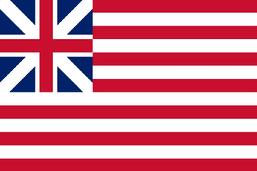 |
| Grand Union Flag, used from July 4, 1776 to June 14, 1777 |
|
| John Hancock was President of the Continental Congress, the provisional government of the United States, during this time. The title "President" referred only to presiding over the legislative body. He, and his successors in that office under the next flag, did not have the executive powers of the Presidents of the United States starting with George Washington.
| Hamden was still part of New Haven at this time.
Jonathan Fitch was the first selectman of the Town of New Haven.
|
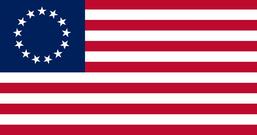 |
| Betsy Ross Flag, 13 stars and 13 stripes representing the 13 original states: Connecticut, Delaware, Georgia, Maryland, Massachusetts, New Hampshire, New Jersey, New York, North Carolina, Pennsylvania, Rhode Island, South Carolina, Virginia |
|
| Presidents of the Continental Congress:
John Hancock
Henry Laurens
John Jay
Samuel Huntington
Thomas McKean
John Hanson
Elias Boudinot
Thomas Mifflin
Richard Henry Lee
John Hancock
Nathaniel Gorham
Arthur St. Clair
Cyrus Griffin
| First Selectmen of New Haven:
Jonathan Fitch
Timothy Jones
John Hubbard
Thomas Howel
Joseph Howel
James Rice
|
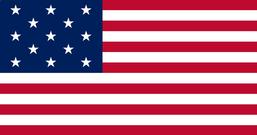 |
| Widely-used version of the 13-star flag, used from June 14, 1777 to May 1, 1795 |
|
| Presidents of the United States:
George Washington
| First Selectmen of Hamden:
John Hubbard
Theophilus Goodyear
Medad Atwater
Isaac Dickerman
Joel Ford
Theophilus Goodyear
Simeon Bristol
|
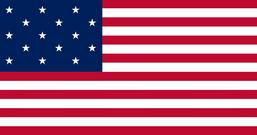 |
| 15-star and 15-stripe flag, adopted May 1, 1795 for admission of Vermont and Kentucky |
|
| George Washington
John Adams
Thomas Jefferson
James Madison
James Monroe
| Ezra Ives
John Hubbard
Hezekiah Dickerman
Caleb Alling
Isaac Dickerman
Philemon Potter
Alvin Bradley
Amasa Bradley
Chauncey Dickerman
Russell Pierpont
Levi Gorham
Hezekiah Warner
Jared Atwater
Daniel Chatterton
Joel Ford
Justis Humiston
Zadoc Allen
|
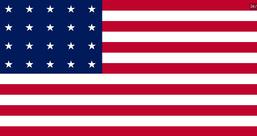 |
| 20-star flag, adopted July 4, 1818, for admission of Tennessee, Ohio, Louisiana, Indiana, and Mississippi |
|
| James Monroe
| Zadoc Allen
Lyman Atwater
|
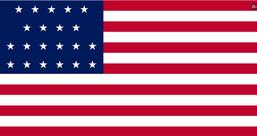 |
| 21-star flag, adopted 1819 for admission of Illinois |
|
| James Monroe
| Lyman Atwater
Allen Dickerman
|
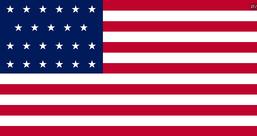 |
| 23-star flag, adopted 1820 for admission of Alabama and Maine |
|
| James Monroe
| Allen Dickerman
Elam Warner
|
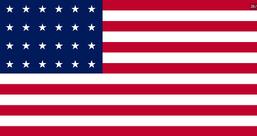 |
| 24-star flag, adopted 1822 for admission of Missouri |
|
| James Monroe
John Quincy Adams
Andrew Jackson
| Elam Warner
Arba Dickerman
Joel Ford
Alfred Bassett
Elias Cooper
Allen Dickerman
Roderick Kimberley
Leverett Tuttle
Jesse Mansfield
Sterling Bradley
Lewis Heaton
Harvey Bradley
|
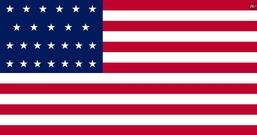 |
| 25-star flag, adopted 1836 for admission of Arkansas |
|
| Andrew Jackson
Martin Van Buren
| Harvey Bradley
Amos Peck
|
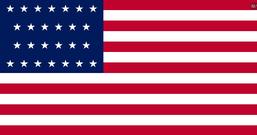 |
| 26-star flag, adopted 1837 for admission of Michigan |
|
| Martin Van Buren
William Henry Harrison
John Tyler
James K. Polk
| Amos Peck
Alfred Bassett
Lewis Warner
James Ford
Peter Van Houten
Lewis Warner
Griswold Gilbert
Horace Potter
Abial Leonard
|
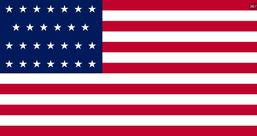 |
| 27-star flag, adopted 1845 for admission of Florida |
|
| James K. Polk
| Abial Leonard
Harvey Bradley
|
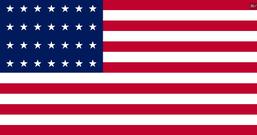 |
| 28-star flag, adopted 1846 for admission of Texas |
|
| James K. Polk
| Harvey Bradley
Henry Munson
|
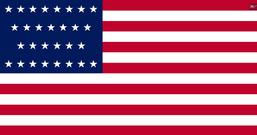 |
| 29-star flag, adopted 1847 for admission of Iowa |
|
| James K. Polk
| Henry Munson
Jesse Mansfield
|
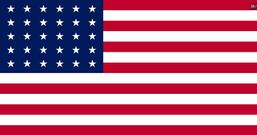 |
| 30-star flag, adopted 1848 for admission of Wisconsin |
|
| James K. Polk
Zachary Taylor
Millard Fillmore
| Jesse Mansfield
Rufus Dorman
Griswold Gilbert
|
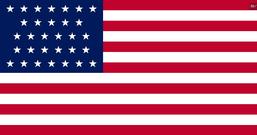 |
| 31-star flag, adopted 1851 for admission of California |
|
|
Millard Fillmore
Franklin Pierce
James Buchanan
| Griswold Gilbert
James Ford
Griswold Gilbert
Merrit Ford
|
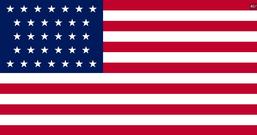 |
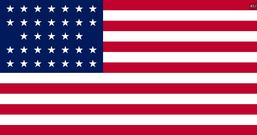
| 32-star flag, adopted 1858 for admission of Minnesota |
|
|
| Merrit Ford
Charles Brockett
|
 |
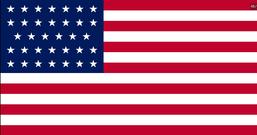
| 33-star flag, adopted 1859 for admission of Oregon |
|
|
James Buchanan
Abraham Lincoln
| Charles Brockett
|
 |
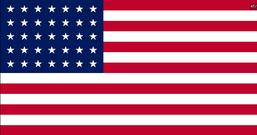
| 34-star flag, adopted 1861 for admission of Kansas |
|
| Abraham Lincoln
|
Charles Brockett
Lewis Warner
|
 |
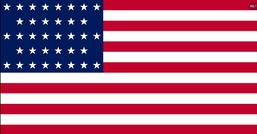
| 35-star flag, adopted 1863 for admission of West Virginia |
|
|
Abraham Lincoln
Andrew Johnson
| Lewis Warner
Merrit Ford
Norris Mix
|
 |
| 36-star flag, adopted 1865 for admission of Nevada |
|
| Andrew Johnson
|
|
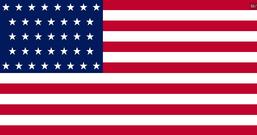 |
| 37-star flag, adopted 1867 for admission of Nebraska |
|
| Andrew Johnson
Ulysses S. Grant
Rutherford B. Hayes
| Henry Tuttle
Merrit Ford
Henry Tuttle
Andrew J. Doolittle
Norris Mix
|
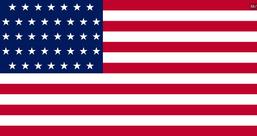 |
| 38-star flag, adopted 1877 for admission of Colorado |
|
| Rutherford B. Hayes
James A. Garfield
Chester A. Arthur
Grover Cleveland
Benjamin Harrison
| Norris Mix
Charles Augur
Edwin Potter
Leverett Dickerman
Charles Augur
John Andrews
|
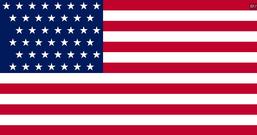 |
| 43-star flag, adopted 1890 for admission of North Dakota, South Dakota, Montana, Washington, and Idaho |
|
| Benjamin Harrison
| John Andrews
Frederick Tuttle
|
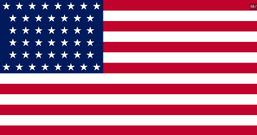 |
| 44-star flag, adopted 1891 for admission of Wyoming |
|
|
Benjamin Harrison
Grover Cleveland
| Frederick Tuttle
Friend Peck
Frederick Tuttle
John Davis
|
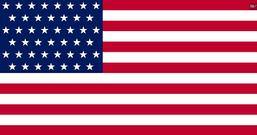 |
| 45-star flag, adopted 1896 for admission of Utah |
|
| Grover Cleveland
William McKinley
Theodore Roosevelt
| John Davis
Horace Johnson
Charles Warner
William Downer
Lester Jones
Burton Potter
James Doolittle
Arthur Woodruff
|
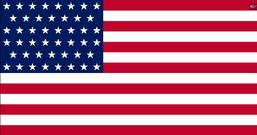 |
| 46-star flag, adopted 1908 for admission of Oklahoma |
|
| Theodore Roosevelt
William Howard Taft
| Arthur Woodruff
Edward Sanford
|
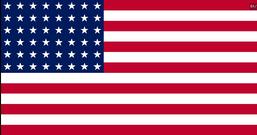 |
| 48-star flag, adopted 1912 for admission of New Mexico and Arizona |
|
| William Howard Taft
Warren G. Harding
Calvin Coolidge
Herbert Hoover
Franklin D. Roosevelt
Harry S. Truman
Dwight D. Eisenhower
| Edward Sanford
Burton Jones
Edward Sanford
George Warner
F. Raymond Rochford
Michael J. Whalen
Leon Booth
Herbert Hume
John DeNicola
|
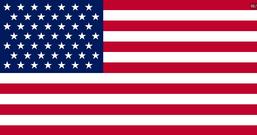 |
| 49--star flag, adopted 1959 for admission of Alaska |
|
| Dwight D. Eisenhower
| John DeNicola
|
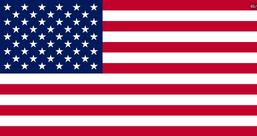 |
| 50-star flag, adopted 1960 for admission of Hawaii |
|
| Dwight D. Eisenhower
John F. Kennedy
Lyndon B. Johnson
Richard Nixon
Gerald Ford
Jimmy Carter
Ronald Reagan
George H. W. Bush
Bill Clinton
George W. Bush
Barack Obama
Donald Trump
Joe Biden
Donald Trump
| Mayors of Hamden:
John DeNicola Sr.
William Adams
Lucien DiMeo
Richard Harris
Peter Villano
John DeNicola Jr.
John Carusone
Lillian Clayman
Barbara DeNicola
Carl Amento
Craig Henrici
Scott Jackson
Curl Balzano Leng
Lauren Garrett
Adam Sendroff
|
|